In the realm of mental health, the relationship between Attention Deficit Hyperactivity Disorder (ADHD) and Eating Disorders is gaining attention for its complexity. Though seemingly unrelated, these two conditions share intricate links that influence various aspects of an individual’s life. This blog post focuses on exploring the nuanced interconnection between ADHD and eating disorders.
Impulsivity, Inattentiveness and Emotional Dysregulation:
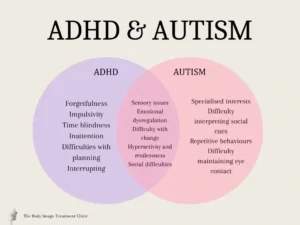
Both ADHD and eating disorders are marked by impulsivity and emotional dysregulation. Individuals with ADHD may grapple with impulsive behaviours, extending to their relationship with food. Emotional dysregulation, a common trait in both conditions, can further complicate the ability to maintain a healthy relationship with food, potentially leading to disordered eating patterns. A more surprising finding is that of the symptoms associated with both ADHD and Eating Disorders, inattentiveness was found to be the most prominent, in particular in Bulimia Nervosa and Disordered Eating.
Coping Mechanisms:
The challenges associated with ADHD may prompt the development of maladaptive coping mechanisms. Turning to food as a source of comfort or control, individuals with ADHD may inadvertently foster unhealthy eating patterns that can escalate into full-blown eating disorders. Coping strategies that originate from ADHD-related difficulties may contribute to the development and perpetuation of disordered eating behaviours.
Executive Functioning Challenges:
ADHD is often characterized by executive functioning challenges, including difficulties in planning and organization. These challenges extend to meal planning and preparation, resulting in erratic eating habits, irregular meal schedules, and reliance on convenience foods. The intersection of executive functioning struggles and disordered eating behaviours forms a significant aspect of the complex relationship between these two conditions.

Shared Neurobiological Factors:
A deeper understanding of the neurobiological underpinnings reveals shared factors between ADHD and eating disorders. Alterations in dopamine regulation, a neurotransmitter associated with reward and pleasure, are implicated in both conditions. Dysregulation in dopamine function may contribute to impulsive behaviours and difficulties in reward processing, creating a potential neurobiological link between ADHD and the development of disordered eating.
Our Clinical Experience:
“One of the main features of ADHD is the presentation of mental and/or physical restlessness. For many, this is coupled with a tendency to thrive in creativity, chaos and/or physical expression and feel constrained or oppressed by structure and containment. This presents unique challenges when implementing evidence-based treatments for eating disorders which are built around structured eating, structured work both in-session and in-between sessions, impulse control, and emotional regulation. Individuals with ADHD tend to also struggle with more prominent and potent inner critics which is known to be an inhibitory factor in the effectiveness of evidence-based treatments for eating disorders. Treatment therefore requires specifics adaptions to assess and utilise the client’s individual strengths and vulnerabilities to develop skills and strategies to manage the features that maintain their eating disorder symptomology”.
– Thomas Midgley CBT & Compassion Focused Psychotherapist, Highly Specialised Eating Disorders Dietitian & Founding Director at The Body Image Treatment Clinic, Harley St, London.
Conclusion:
The interconnection between ADHD and eating disorders goes beyond surface-level observations. Understanding the shared traits, challenges, and neurobiological factors is essential for a comprehensive view of how these conditions can coexist. With this topic becoming more prevalent in the last few years, more research is necessary to establish clear links and identify factors and mechanisms of this bidirectional relationship. With the current research we can already start establishing a better understanding of the interconnectedness of the two conditions and their symptomatology, which can further aid our clinical understanding and allow us to tailor the approaches in the most effective way.
References:
1.https://www.sciencedirect.com/science/article/abs/pii/S02727358163003072.
2.https://journals.plos.org/plosone/article?id=10.1371/journal.pone.00638913.
3.https://www.mdpi.com/2072-6643/12/11/32924.
4.https://link.springer.com/referenceworkentry/10.1007/978-3-031-16691-4_95.
5.https://link.springer.com/article/10.1007/s40501-015-0060-76.
6.https://www.sciencedirect.com/science/article/pii/S027273581630232X